Reference models

Open reference models of the Cyber Digital Twin.

The models we have built and published, each from drawings and public data: a hyperscale AI training campus, grid battery storage, a drone fleet, a satellite and space segment and an agriculture line. Open them and look inside.

How and where this has been done

Every engagement is scoped to the specific facility or product. We start from our reference models, then fit the work to the country, sector and design in front of us.

What sets the scope

  • Country
  • Sector
  • Facility or product type
  • Supply chain
  • Value chain
  • Internal technologies
  • Safety
  • Reliability
  • Minimum operating requirements
  • Compliance requirements for operation, by country and by sector
  • External pressures: geopolitical and cyber attack

We then record the trace of all the software and components used in the system and equipment, back to the country of origin and the manufacturer. Every part and every piece of software stays traceable, which lets compliance be planned on a global scale instead of met after the fact.

Where this has been done

Hyperscale datacenters
Cyber-physical risk models for high-density AI compute halls · the liquid-cooling loops, power trains and thermal limits where a control fault becomes a physical loss · the actuarial case a board can act on
Energy & grid
Australia: grid stability and battery energy storage (BESS) · Deep Fission nuclear installation, Australia

Reference models

Many sectors, one method

Each reference model is built from public information, so it can be examined without a client's data.

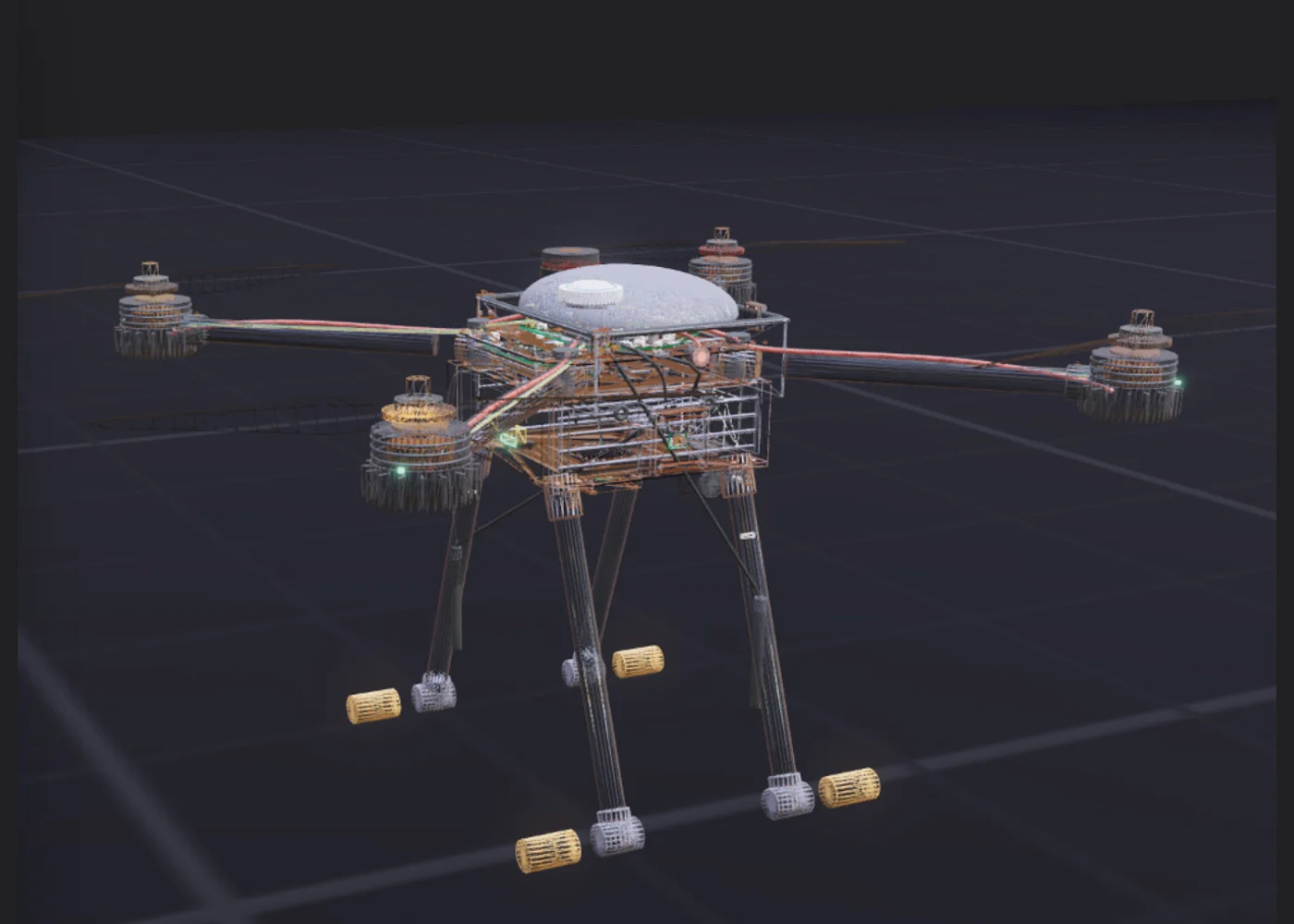
A quadcopter drone shown as a 3D wireframe, with its motors, flight controller stack, landing legs and payload cells.
Reference model

Drone fleet

A drone is a flying computer with a payload, and its risk reaches beyond the airframe. This reference model describes a fleet as one system: the aircraft, the ground station, the controller, the payload and the charging. Each part has its security zone and the conduits that join it to the rest. Hazards are tied to the assets they can harm, and software components are tied to the vulnerabilities published against them. The model holds 140 assets, 54 connections and 45 hazards.
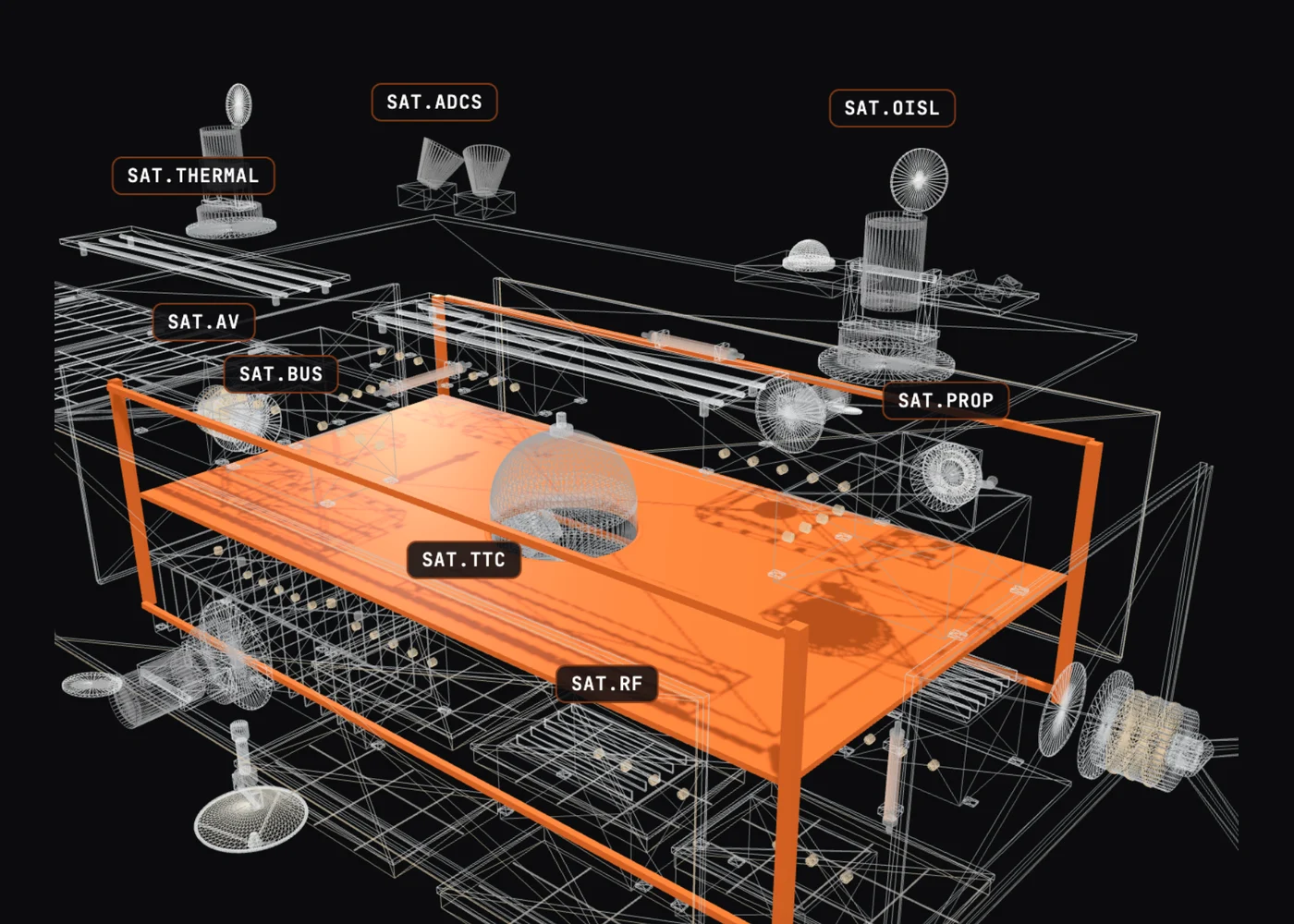
A satellite exploded into labelled subsystems in 3D wireframe: bus, ADCS, propulsion, thermal, telemetry and command, radio, and optical inter-satellite link.
Reference model

Satellite and space segment

A satellite cannot be patched in person, so every subsystem has to be understood before launch. This reference model splits one into its bus, attitude control (ADCS), propulsion, thermal control, telemetry, tracking and command (TTC), radio (RF) and optical inter-satellite links (OISL). Each block is labelled in the 3D view and shows what it depends on. Our jurisdictions globe adds the orbit view: 32 satellites in three constellations, with ground gateways.

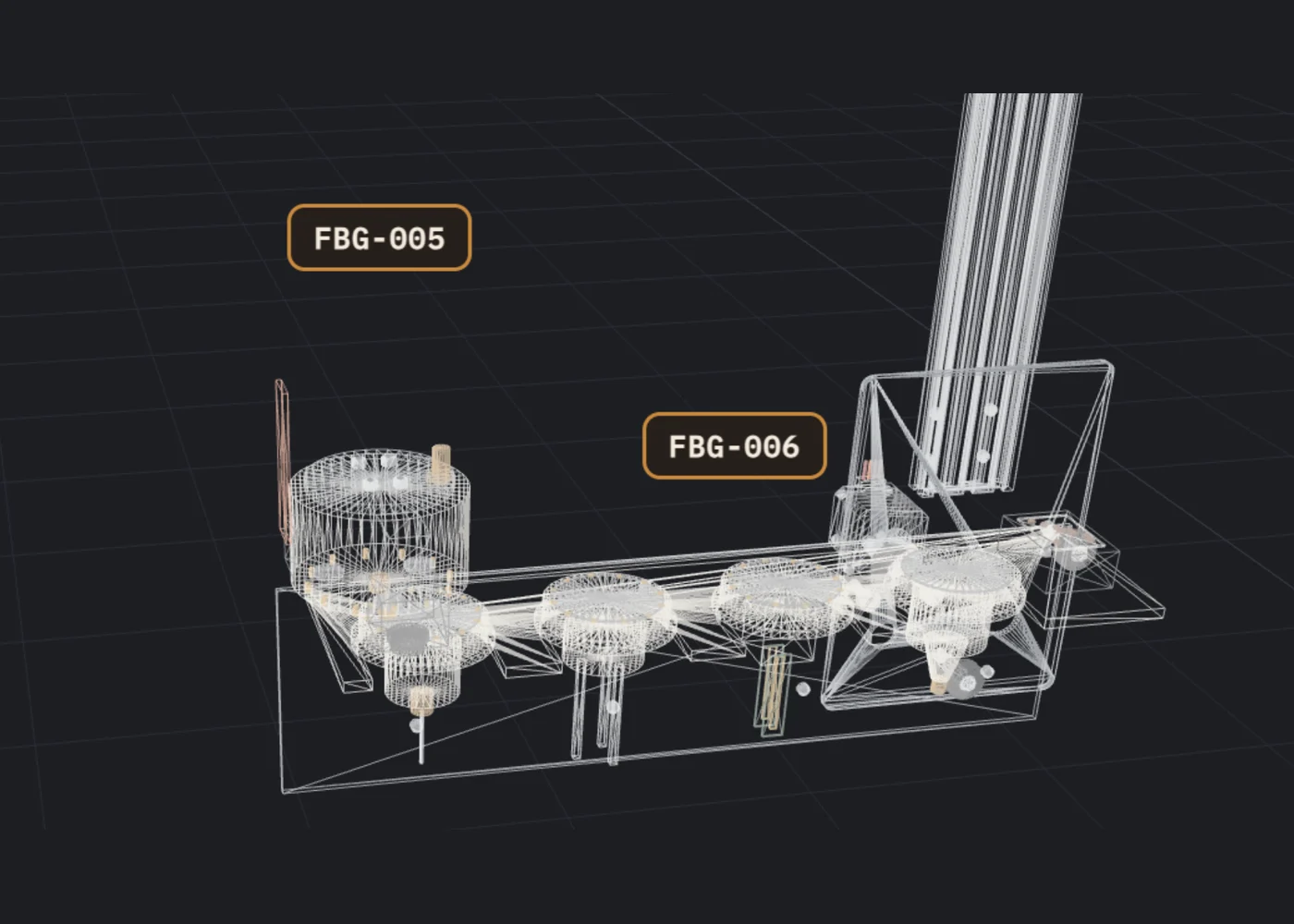
A food processing line shown as a 3D wireframe, with numbered machines FBG-005 and FBG-006 along a conveyor.
Reference model

Agriculture and food processing

Agriculture and food plants are many machines in a fixed order. This reference model lays a line out in 3D, and every machine carries its own asset number (FBG-005, FBG-006 and so on), its place in the process and its security zone. That makes it possible to ask what stops downstream when one machine, or the control system behind it, fails. The model follows the same method as the datacenter and drone models.

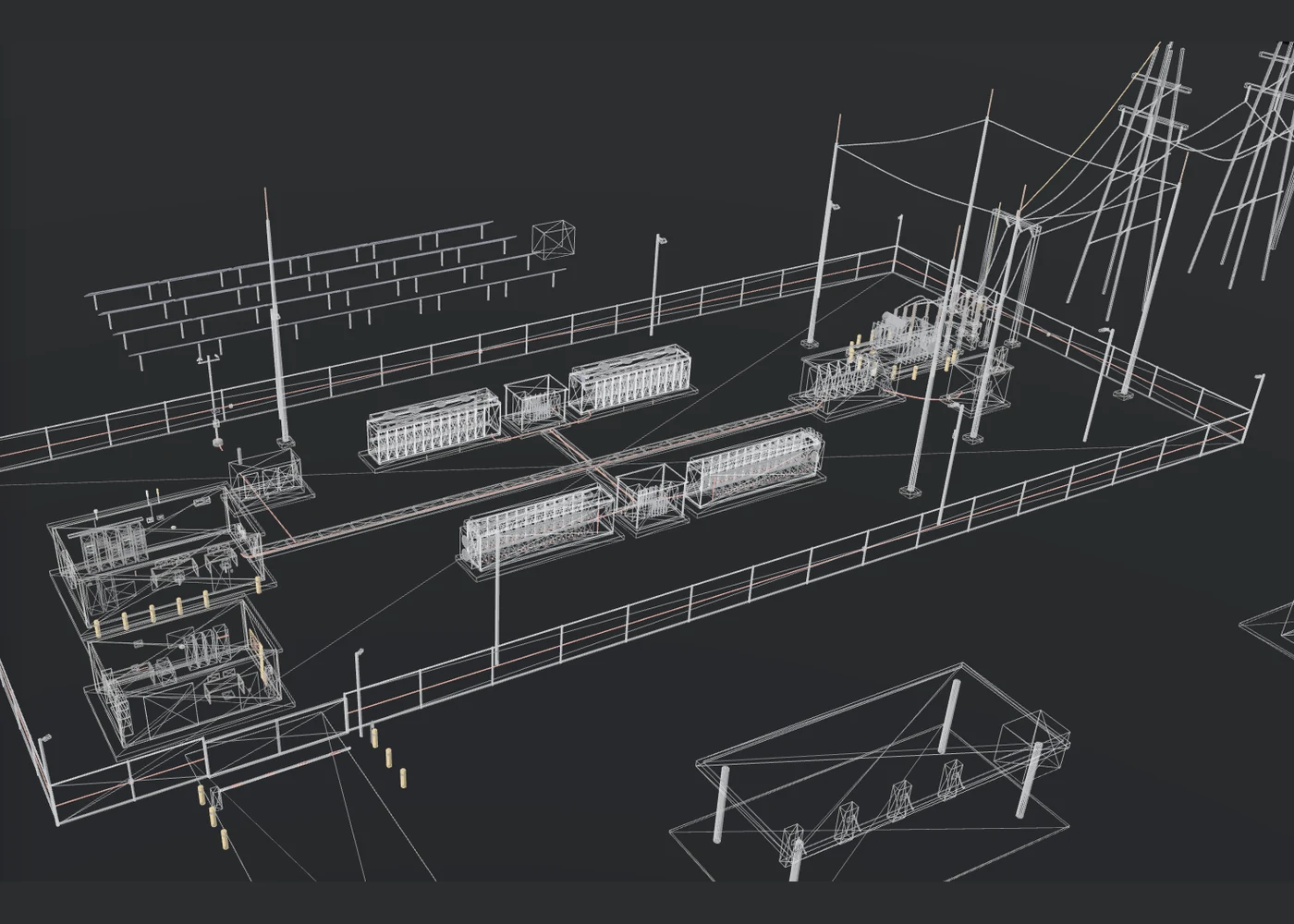
A utility battery site shown as a 3D wireframe: a fenced compound with four battery units in two rows, MV skids, a transformer, a control house and overhead line towers.
Reference model

Grid battery storage (BESS)

A grid battery site is several systems on one fenced pad: batteries, cooling, a substation and links to the outside world. This reference model, BESS-REF-001, is a 78 × 34 m utility site with four integrated battery units of 1,075 kW / 4,300 kWh each, 96 modules in all. Units 1 and 2 are liquid-cooled and units 3 and 4 air-cooled, so both designs sit side by side. Two MV skids step the output up, and a cable trench carries it to the MV switchgear kiosk, the main transformer and the POI breaker. It leaves on overhead line towers to the TSO substation. A control house by the gate holds the site controller, OT network racks and firewalls, operator desks, the fire alarm panel, the UPS and the standby genset. Schematic links reach a PV plant, an aggregator/VPP mast, the operations centre and the vendor cloud.

OPEN REFERENCE MODEL / BATTERY STORAGE

Grid battery storage site, modelled as a Cyber Digital Twin

BESS-REF-001 is a utility battery site of four units, 4.3 MW and 17.2 MWh in all, modelled as a Cyber Digital Twin: every component a record, every interface typed, and the site's behaviour played back on the same model.

It is an open reference model built from public information, with generic control laws. The timeline is a simulation: a grid under-frequency event, a coolant pump trip, a cyber intrusion through vendor remote access, a thermal runaway and a loss of grid, each shown against the assets it touches. It represents no specific installation, operator or vendor's equipment.

The camera follows the sequence on its own, in wireframe. Switch Auto camera off to move it yourself.

modelled assets
195
typed interfaces
458
IP nodes
72
VLANs
15
steps in the simulated sequence
10
public sources
24
LIVE EMBEDDED TWIN / SELDON ENGINEBESS-REF-001 / OPEN REFERENCE MODEL

Eigenia is not affiliated with, sponsored by or endorsed by Tesla, Inc.

Tesla and Megapack are trademarks of Tesla, Inc. The model's battery unit is comparable in envelope and arrangement to a Megapack 2 XL and is not an as-built replica.

OPEN REFERENCE MODEL / HYPERSCALE

Hyperscale AI training facility, modelled as a Cyber Digital Twin

Eigenia modelled a Tier III AI training campus of 96 racks as a Cyber Digital Twin: every component a record, every connection typed and routed, and every security and consequence finding a query against the same dataset.

It is an open-source research model. Its bill of materials, interface control and factory acceptance workbook was compiled by Eigenia from publicly available AMD and industry information, and it represents no specific installation, operator, vendor's equipment or configuration.

This is the first in a series of open reference models. Further models are planned for drones, space systems, breweries, manufacturing facilities and robots.

modelled assets
586
typed connections
1,432
solved physical routes
1,432
cable and pipe containment
21.7 km
zone-crossing conduits
895
hazards, each tied to assets
38
LIVE EMBEDDED TWIN / SELDON ENGINEAI TRAINING CAMPUS / OPEN REFERENCE MODEL

Eigenia is not affiliated with, sponsored by or endorsed by AMD.

AMD, AMD Instinct, EPYC, Pensando and Helios are trademarks of Advanced Micro Devices, Inc. Dell, Arista and Broadcom names are trademarks of their respective owners.

Start with the facility

Send the country, the sector and the facility type. The enquiry form carries the service with it.

This Site Uses No Cookies

Eigenia does not set cookies. The only thing stored in your browser is one preference, saved in local storage, noting that you have seen this notice.